Dove’s Real Beauty Campaign focuses on changing how beauty is perceived by society (Amaral 2017). Through this campaign, many advertisements were released in an attempt to send a strong message out.
Dove effectively incorporated Membership (or associative) groups throughout the advertisements (Solomon, Bennett and Previte 2019). This involves ordinary people who are gathering in order to create a social influence (Solomon, Bennett and Previte 2019). For example, the ‘Dove Change One Thing’ video posted onto YouTube are a bunch of young girls, who are all identifying one thing they wish they could change (Dove Change One Thing | How our girls see themselves 2019).
(Dove Change One Thing | How our girls see themselves 2019).
This video goes hand-in-hand with The Real Beauty Campaign as it effectively illustrates the negative impacts society have on the young. From a young age, girls are already picking at themselves for not being beautiful. This message therefore reveals what Dove is trying to stop.
(Dove 2019)
The above image is another example of where ordinary members are coming together in order to create an impact. This advertisement clearly emphasises how any individual no matter from what cultural background, are beautiful.
References
Amaral, AC, 2017, Dove Real Beauty Campaign: A Local Perspective (Doctoral dissertation)
Dove investigated 118 countries discovering most women were not confident in describing themselves as beautiful1. This pushed Dove into working towards their new goal in changing the way beauty is perceived by the media1. Social media platforms like Instagram are changing the way beauty is perceived. Most women feel they need plastic surgery to feel beautiful, and to fit in with celebrities1.
13
5
This video illustrates how young girls are beginning to sound a lot like grown women in not being able to define themselves as beautiful5. Dove is raising awareness in an attempt to stop this horrible chain reaction1. Women are the role models for young girls, and Dove recognises this as a huge issue since women are not demonstrating what real beauty is about1.
Perception
TheReal Beauty Campaign promoted beauty to be the power and personality of individuals, and is still an ongoing campaign to this day1. Dove also created a Self Esteem Fund to emphasise the importance of feeling beautiful from within1.
As a result of marketing campaigns, many described their perception towards the brand to increase their self-esteem1. The strong message redefining beauty changed the way consumers interpreted Dove.
7
Packaging Design Influencing Consumer Perception
The packaging design of Dove products also contributes to the increasing sales and level of awareness11. Dove usually incorporates a white background on products. The colour white symbolises youth, truth, fearfulness and cleanliness11. Blue is another colour most frequently included for the font and logo colour. Blue represents trust, confidence wisdom and creativity11.
2
The incorporation of a Dove bird as part of the logo also supports the idea Dove is portraying4. It is a connotation for “femininity, peace, tenderness”, which symbolises the natural beauty of women4. The Dove bird also demonstrates the feeling women will experience after using the products4.
Emotions may include “softness, tenderness, and joy”4. It is about encouraging and influencing women to make peace with their inner-beauty, and to accept who they are4.
These connotations link immensely to the purpose of The Real Beauty Campaign, as they redefine beauty not only through words, but through the product packaging1.
8
Sensory System and
Receptors
In addition, the sensory system theory allows consumers to feel positive emotions1. The range of soft scents promotes a calm feeling as they utilise their nose receptors, motivating them to purchase the product9. The feel of their skin following the use of products like moisturisers, also relate to the sensory system of touch10.
The nose and skin are the main sensory receptors Dove utilises, which set the mood for consumers to have a desire to purchase Dove products9. The calm mood created also promotes consumers to feel youthful and joyful when purchasing and using Dove products4.
6
Effective ads
Dove is also effective in stating their key messages through advertisements. In this advertisement, the faces are on the left, while the key message is depicted on the right.
According to the Attention Getting Hierarchy, consumers will view the visual imagery of the faces before the text12. This means once they see three different faces, they will be able to interpret the meaning behind the advertisement once they read the message on the right.
Therefore, Dove effectively conveys relevant information, which builds their brand knowledge of their brand purpose3.
References
1 Amaral, AC, 2017, Dove Real Beauty Campaign: A Local Perspective (Doctoral dissertation)
3 Bergkvist,
LR, Eiderbäck, D and Palombo, M, 2012, The
brand communication effects of using a headline to prompt the key benefit in
ads with pictorial metaphors, Journal
of Advertising, 41(2),
pp.67-76
4 Dharmayanti,
IGAD, Tika, IK and Sudana, IGP, 2016,
Lexical Ambiguity in English Advertisement Slogans of Unilever Products,
p95
9 Herz,
RS, 2011, The emotional, cognitive, and
biological basics of olfaction: implications and considerations for scent
marketing, In Sensory Marketing, pp. 117-138, Routledge
10 Klatzky, RL, 2011, A Gentle tutorial With Implications for Marketing, Sensory Marketing:
Research on the Sensuality of Products, p.33,
11 Mohebbi, B, 2014, The art of packaging: An investigation into the role of color in packaging, marketing, and branding, International Journal of Organizational Leadership, 3(2)
The self-concept refers to the evaluation and beliefs consumers hold about themselves7. Not every aspect you view of yourself may be positive, there might be some attributes you view negatively too7. This is developed over time through psychological and social factors, and during interactions7.
5
This strongly connects to Dove’s campaign, The Real Beauty Campaign, on promoting how women should feel comfortable in their own skin6. Designing different shaped bottles were used as a way to represent the different body shapes6. Dove also concluded women felt pressure from social media, in looking a certain way to be identified as beautiful6.
Therefore, this proves consumers who purchase Dove products are following the self-concept theory, as they purchase products close to their self-image7. Consumers aim to feel beautiful and by doing so, they believe Dove can offer that. By purchasing these products, they have identified Dove’s brand values to match with their personal values7.
4
Self-esteem
This campaign also relates to self-esteem. Self-esteem refers to “the positivity of a person’s self-concept”7. An example may be the level of confidence one holds when performing a task7. In this case, it might be the way one feels when in looking in the mirror, and liking what they see.
Increasing attention towards the different body shapes of women, aims to increase self-esteem6. It promotes women to feel comfortable in their own bodies, for example, when wearing a bikini and heading down to the beach in summer. It is also about embracing your natural self, and not feeling like social media is controlling your mind.
Social Comparison
Dove’s campaign aims to avoid social comparison, where consumers are comparing themselves to idealised images such as celebrities on Instagram7. Dove also aims to move consumers from an ideal self-mindset, how the consumer would like to be, to an actual self mindset where consumers are realistic with who they are2. By doing so, when individuals purchase a Dove product, it is a constant reminder to be kind to themselves.
3
Personality
The way consumers perceive and respond to Dove’s marketing campaigns depend on their personality7. Dove’s campaigns can clearly be identified as a goal to change the current personalities of consumers, who believe they need to look a certain way to be beautiful1.
This can be analysed again through the Real Beauty Campaign, where it aimed to restore self-confidence in women1. Through this campaign, Dove created a clear message where it illustrated how beauty starts within your own personality1.
This also links with brand personality where consumers are using Dove’s personality of freedom, love and beauty to the person they wish to evolve into1.
Trait Theory
Since the Trait Theory focuses on psychological characteristics, Dove can be recognised as a brand who focuses on conscientiousness7 .
8
Therefore, Dove’s goal is to ensure consumers feel beautiful, despite individuals believing they are flawed7. This is accomplished through changing consumers psychological mindset.
References
1 Amaral, AC, 2017, Dove Real Beauty Campaign: A Local Perspective (Doctoral dissertation)
2 Bissell, K and Rask, A, 2010, Real women on real beauty: Self-discrepancy, internalisation of the
thin ideal, and perceptions of attractiveness and thinness in Dove’s Campaign
for Real Beauty, International
Journal of Advertising, 29(4),
pp.643-668.
6 Powell,
M, 2015, Radical Love In A Post-Feminist
Age: Reading the Pedagogy of Dove’s” Campaign For Real Beauty”, International
Journal of Critical Pedagogy, 6(1).
7 Solomon, Michael, Russell-Bennett, R and Previte, J, 2019, Consumer Behaviour, Australian Edition, 4th Ed., Pearson, p.212
Attitude is referred to as the way a consumer is positive or negative towards a brand or product (Solomon, Bennett, Previte 2019).
The formation of attitudes can can developed through many ways:
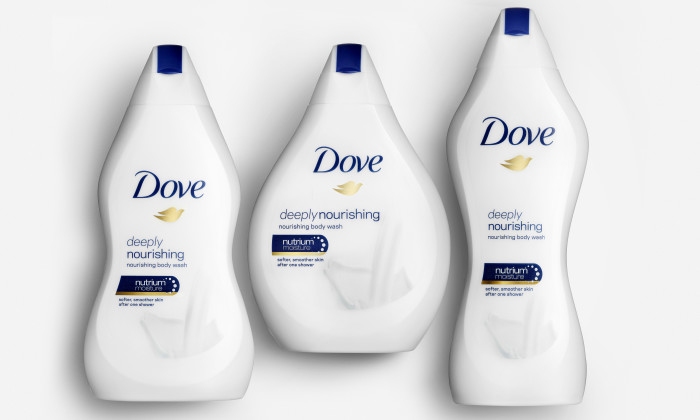
Direct marketing, which has been noted throughout many of Doves campaigns towards the beauty of women, is another way consumers form an attitude towards the brand (Solomon, Bennett, Previte 2019). It is targeting all women no matter what size, shape, age they are to feel confident. For example, Dove designed different shaped bottles in representing various body shapes (Marketing 2017). Dove also researched that 1 in 2 women felt pressure from social media to dress and act in a certain way to be identified as beautiful (Marketing 2017).
Dove Image (Marketing 2017)
This statistic also ties in with the way consumers base their attitude on Dove products from the internet (Solomon, Bennett, Previte 2019). Social media is a growing platform where consumers learn about products, and see their favourite influencers promoting brand. If Dove is promoting beauty to be women of all shapes and sizes, a positive attitude towards the brand is likely to occur.
Dove Image (Beauty Packaging 2019)
Direct personal experience is where consumers use the product and form an attitude towards it (Solomon, Bennett, Previte 2019). Relating to the campaigns about feeling beautiful from within, if women feel using Dove products enables them to feel beautiful, then it can be concluded the campaign is effective leading women to have positive experiences (Marketing 2017)
Therefore, these example support the Dove consumers attitudes are learned as a result from marketing campaigns (Solomon, Bennett, Previte 2019).
References
Beauty Packaging, Image, 2019, viewed 27 March 2019,
Motivation refers to the way consumers create choices to purchase products (Kaur 2013). There are theories surrounding this topic, to help us understand the motivations behind decisions.
Image: Simply Psychology (2019)
Maslow’s Hierarchy of Needs describes this theory under five levels, in a hierarchical manner (Kaur 2013). He believes we have five types of needs, and are organised from lowest to highest (Kaur 2013). This theory also states that in order to move up this hierarchy, the lowest level must be satisfied first (Kaur 2013).
Dove can be identified as an esteem need (Kaur 2013). This refers to the psychology need consumers feel to gain confidence (Kaur 2013). Consumers purchase Dove products to feel confident in their skin, and perhaps like the way it makes their body feel smooth and refreshed.
Also, there are two theories of motivational strength – the Drive and Expectancy theory (Solomon, Bennett and Previte 2019). The Drive theory refers to the biological needs leading to an unpleasant state of arousal (Solomon, Bennett and Previte 2019). For instance, when a consumers feel their skin is not its softest, it drives them to purchase a Dove creme. As a result, it will improve the softness of the skin.
The Expectancy theory refers to the way consumers behave in a certain way as they believe will achieve a positive outcome they expect (Solomon, Bennett and Previte 2019). For example, consumers may choose Dove cremes over Vaseline cremes as Dove is expected and perceived to produce better softness.
References
Kaur, A, 2013, Maslow’s need hierarchy theory: Applications and criticisms, Global Journal of Management and Business Studies, 3(10), pp.1061-1064.
Simply Psychology, 2019, Maslow’s Hierarchy of Needs, image, viewed 4 May 2019,
The self-concept refers to “the beliefs a person hold about their own attributes and how they evaluate these qualities” (Solomon et al, 2019, p.211). Not every aspect you view yourself may be positive, there might be some attributes you view negatively too (Solomon et al, 2019). It is developed over time through psychological and social factors, and interactions (Solomon et al, 2019).
Dove Image (Marketing 2017)
This strongly connects to Dove campaign on promoting how women should feel comfortable in their own skin (Marketing 2017). Designing different shaped bottles was used as a way to represent the different body shapes (Marketing 2017). Dove also found 1 in 2 women feel pressure from social media in looking a certain way to be perceived as beautiful (Marketing 2017).
Dove Image (Marketing 2019)
This campaign also relates to self-esteem. Self-esteem refers to “the positivity of a person’s self-concept” (Solomon et al, 2019, p.212). An example may be the level of confidence one has when performing a task (Solomon et al, 2019). In this case, it might be the way one feels positive in looking in the mirror and liking what they see.
Increasing attention towards the different body shapes of women, aims to increase self-esteem (Marketing 2017). It promotes women to feel comfortable in their bodies for example when wearing a bikini, and going to the beach in the summertime. It is also about embracing your natural self, and to not feel like social media is controlling your mind.
References
Marketing, People aren’t buying into Dove’s body wash bottle campaign, 2017, accessed 23 April 2019,
Classical conditioning is a form of learning resulting in one stimulus leading to a response when paired with another stimulus (Solomon et al, 2019). After a certain amount of time, it leads a consumer in creating a similar response as it is associated with the first stimulus (Solomon et al, 2019). This idea is central to consumers who purchase Dove products.
Dove image (Bustle 2019)
Stimulus generalisation is a marketing concept Dove effectively relates to. It is outlined to occur “when one response is extended to a second stimulus similar to the first” (Lamb, Hair and McDaniel 2008, p.169).
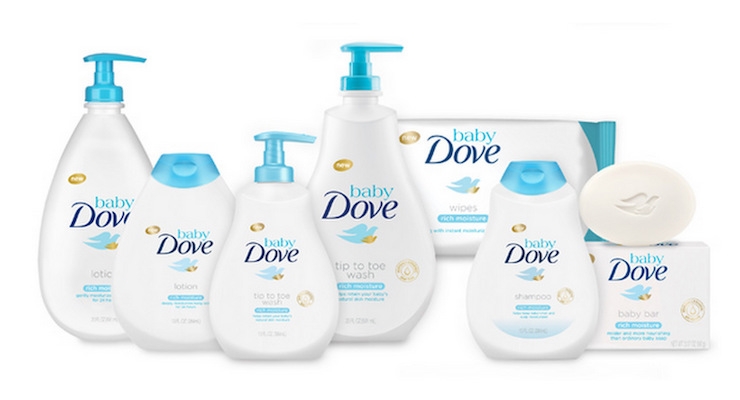
Dove has expanded into family branding over the years, offering various products to suit everyone. This includes items like soap, skin cleaners, moisturisers, deodorant, wipes, shampoos and conditioners (Amaral 2017). Dove ensures its products can be used for both men and women, including babies.
Dove Image (Beauty Packaging 2019)
Since they have a wide range of products, it provides consumers with familiarity and knowledge towards the brand (Lamb, Hair and McDaniel 2008). As consumers learn more about each product in the Dove family, it encourages them to try different items. For instance, most consumers will know of Doves first product ‘Dove Soap’ (Lamb, Hair and McDaniel 2008). When consumers purchase the Dove Shampoo, they will be familiar with Dove Soap and trust the product (Lamb, Hair and McDaniel 2008).
Similarly, I have used the Dove Soap where I experienced a positive outcome. Since I was satisfied with the product and the amount of moisture , I decided to try the Dove moisturiser which was in the same family. This relates to stimulus generalisation.
Reference
Amaral, A.C., 2017. Dove Real Beauty Campaign: A Local Perspective (Doctoral dissertation), viewed 2 April 2019,
Dove is successfully known as a cosmetics brand, primarily focusing on bettering our skin. Through their product expansion over the years, they offer a wide range of products. This includes soaps, shampoos, deodorants, lotions and cleansers (Amaral 2017).
Dove investigated 118 countries discovering most women were not confident in describing themselves as beautiful (Amaral 2017). This pushed Dove into working towards their new goal of changing the way Beauty is perceived by the media (Amaral 2017). Social media platforms like Instagram also change the way beauty is perceived. Most women feel they would need to have plastic surgery to be beauty and fit in with celebrities.
The Real Beauty Campaign promoted beauty to be the power and personality of individuals, and is still an ongoing campaign to this day (Amaral 2017). They also created a Self Esteem Fund to emphasise the importance of feeling beautiful from within (Amaral 2017). As a result of marketing campaigns, many described their perception towards the brand to increase their self-esteem (Amral 2017). The strong message redefining beauty changed the way consumers saw Dove.
Dove Image (Beauty Packaging 2019)
The packaging design of Dove products has also contributed to increasing sales and awareness. Dove usually incorporates a white background on products. The colour white symbolises youth, truth, fearfulness and cleanliness (Mohebbi 2014). Blue is another colour most frequently used for the font and logo colour. Blue represents trust, confidence wisdom and creativity (Mohebbi 2014).
The use of a Dove bird as part of the logo supports the idea Dove is portraying. It is a connotation for “femininity, peace, tenderness” that symbolises the natural beauty of women (Dharmayanti, Tika and Sudana 2016, p.95). The Dove bird also demonstrates the feeling women will experience after utilising the products (Dharmayanti, Tika and Sudana 2016). Emotions may include “softness, tenderness, and joy” (Dharmayanti, Tika and Sudana 2016, p.95). It is about encouraging women to make peace with their inner-beauty (Dharmayanti, Tika and Sudana 2016).
These connotations link to the purpose of the Real Beauty Campaign, as they redefine beauty to personality, power and how women feel within (Amaral 2017).
In addition, the sensory systemtheory allows them to feel positive emotions (Amaral 2017). The range of soft scents promotes a calm feeling. The feel of their skin after using the products may also add the their sensory system.
References
Amaral, A.C., 2017. Dove Real Beauty Campaign: A Local Perspective (Doctoral dissertation), viewed 27 March 2019,
Dharmayanti, I.G.A.D., Tika, I.K. and Sudana, I.G.P., 2016, Lexical Ambiguity in English Advertisement Slogans of Unilever Products, viewed 27 March 2019,
Mohebbi, B., 2014. The art of packaging: An investigation into the role of color in packaging, marketing, and branding. International Journal of Organizational Leadership, 3(2), viewed 27 March 2019,
When a consumer makes a decision, there are several possibilities in how they could have gone about it.
Quite often, I purchase my work lunch from a near-by cafe. Since my job is located in a small shopping center, I have little choice due to the limited food stores. After sticking to Luna Espresso for over a year, and ordering the same meal, I no longer look at the menu. A beef burger with a side of hot chips for $8.50 sounds good to me.
Burger Mean Image (Taste 2019)
This decision relates to habitual decision-making under the three buckets of consumer decision-making model (Solomon et al. 2019). It refers to a consumer creating a conscious decision (Solomon et al. 2019). Therefore, this is identified as a routinised-response behaviour (Solomon et al. 2019). It requires minimal effort, and at times we may not realise how automatic we are behaving (Solomon et al. 2019). When it comes to lunch time, I automatically walk towards the cafe without thinking too much about it. Throughout the morning, I do not think about what I am feeling for lunch. It is almost like my body already knows.
I would consider my purchase behaviour to be a repeat purchase (Solomon et al. 2019). Since I am always satisfied with the finished product, I find myself returning to the same store to order the same meal.
I sometimes wonder at what point did I have a realisation that I had been behaving in a repetitive and autopilot mode?
Another reason why I continue purchasing the same deal is because of the cheap price, convenience and how quickly it is made.
This decision shows I am thinking under the mental budget concept (Solomon et al. 2019). My intentions on how much I am willing to spend is reflected by my choice.
Budget Image (National Council 2019)
Since I have no negative experiences with my cheap meal, my perceived risk of my burger being under cooked is low (Solomon et al. 2019). This type of perceived risk is known as functional risk (Solomon et al. 2019). It refers to my expectations of how my meal is cooked compared to previous times. This relates to a pre-purchase search as I am relying on my previous purchases at the Cafe, to create a decision (Solomon et al. 2019). With the positive past experiences, I am confident in making the same decision. My confidence and trust increases with each successful order.
Risk Image (Business Reporter 2019)
After my most recent purchase, I can say that my post-purchase evaluation is once again ‘satisfied’ (Solomon et al. 2019). For this reason I will be returning back again.
Business Reporter, 2019, image, viewed 22 March 2019,
Deviant consumer behaviour has the ability to diminish an organisations image, affect an organisations employees and other consumers (Dootson et al., 2018).
There are laws in place stating the implications of shoplifting, however, it still does not stop consumers from performing such an act (Daunt & Harris 2012). Consumers are well aware supermarkets like Coles have installed cameras and security guards, but they would still go ahead with violating the policies of Coles (Daunt & Harris 2012). While the implementation of self-serve checkouts have created a positive experience for most, this has promoted the opportunity for some to intentionally skip items when scanning (Solomon 2019).
(Inside Retail Australia, 2018)
Jager (2013) researched Australia had lost $112 billion as a result of consumers shoplifting a product, and returning it back to that store requesting a refund. This is known as a fradulent refund (Jager 2013). Where an organisation accepts high volumes of fradulent refunds, this could increase even more through word of mouth by that consumer. They may mention it to a friend how easy it was to get away with it, encouraging others to do the same. By time the organisation catches onto it, they may have already lost a high amount of revenue.
So why is it that consumers are willing to take on the risks of shoplifting, even though they are aware of the consequences?
The emotions of a consumer have been researched to be a factor in creating an ethical or unethical decision (Singh 2018). Those who have a sense of fear think about the moral implications of their actions (Singh 2018). Consumers who are in an angry state of mind tend to carry out unethical behaviours (Singh 2018). Therefore, a consumer may have morals but can disregard them depending on their state of mind.
As a consumer, it is important we understand our emotions. If they are telling us to be unethical, we need to remind ourselves of the consequences.
Daunt, K. L., & Harris, L. C. (2012). Motives of dysfunctional customer behavior: An empirical study. Journal of Services Marketing, 26(4), 293–308.
Dootson, P., Johnston, K.A., Lings, I. and Beatson, A., 2018. Tactics to deter deviant consumer behavior: a research agenda. Journal of Consumer Marketing, 35(6), pp.577-587.
Inside Retail Australia, image, 2018, viewed 15 March 2019
Singh, J.J., Garg, N., Govind, R. and Vitell, S.J., 2018. Anger Strays, Fear Refrains: The Differential Effect of Negative Emotions on Consumers’ Ethical Judgments. Journal of Business Ethics, 151(1), pp.235-248.
Our credit score is something we may closely monitor to ensure appropriate decisions are made. As a consumer, it is important we think about how decisions can affect the chances of becoming creditworthy.
(Credit Score Image: Cafe Credit 2019)
A credit score refers to those techniques a lender undertakes in determining whether a consumer can be granted a loan (Thomas, Crook & Edelman 2017). It assesses the likelihood of a borrower handling economic scenarios they may face in the short-term and long-term (Thomas, Crook & Edelman 2017). A credit score will determine if a consumer is deemed creditworthy or uncreditworthy (Thomas, Crook & Edelam 2017).
To be creditworthy, we can be offered exceptional offers from our banks. Obtaining a high credit score provides us the ability to have greater negotiating power, borrowing higher amounts, a better opportunity to be accepted for a credit card or loan approval, and a lower interest rate (CANSTAR 2019).
Therefore, consumers may carefully and strategically monitor their spending to avoid a poor credit score. They may change from paying their bills late, to paying them on time. Additionally, they may save more of their weekly income in order to consistently pay extra on their current loans. This idea will therefore alter the consumer’s behaviour, as they are becoming more conscious when managing their earnings.






 bank.fashion.blog